
Compare Cleburne County Property Value Types
One parcel can carry several different figures. Cleburne County assessment cards break value into land, building, total appraised, and assessed amounts. Each number answers a different question. A deed adds its own figure, the transaction consideration. That reflects what changed hands rather than what the assessor calculated. An independent appraisal is different again, estimating value for one specific date and purpose.
| Value type | What it means | Where recorded |
|---|---|---|
| Appraised or fair-market value | Mass-appraisal estimate used in assessment | Revenue/GIS parcel card |
| Assessed value | Appraised value after the state class percentage | Assessment record |
| Taxable assessed value | Assessment after applicable status, cap, or exemption treatment | Tax system |
| Last sale or consideration | Transaction clue, not a current appraisal | Parcel card or deed |
Match dates and match fields. A prior sale price and a current assessment can disagree, and neither record is wrong.
Look Up a Cleburne County Assessed Value
Start with the Cleburne County GIS and search by address or parcel number. Open the property record card from there. Write down the valuation year, classification, land amount, building amount, total appraised value, assessed value, and any sale fields before you close it.
- Match the parcel through its legal description.
- Note the assessment year and card access date.
- Read land and improvements separately.
- Check the class before interpreting assessed value.
- Treat sale and deed references as separate transaction clues.
The sample county value card shows the field groupings used for this comparison.
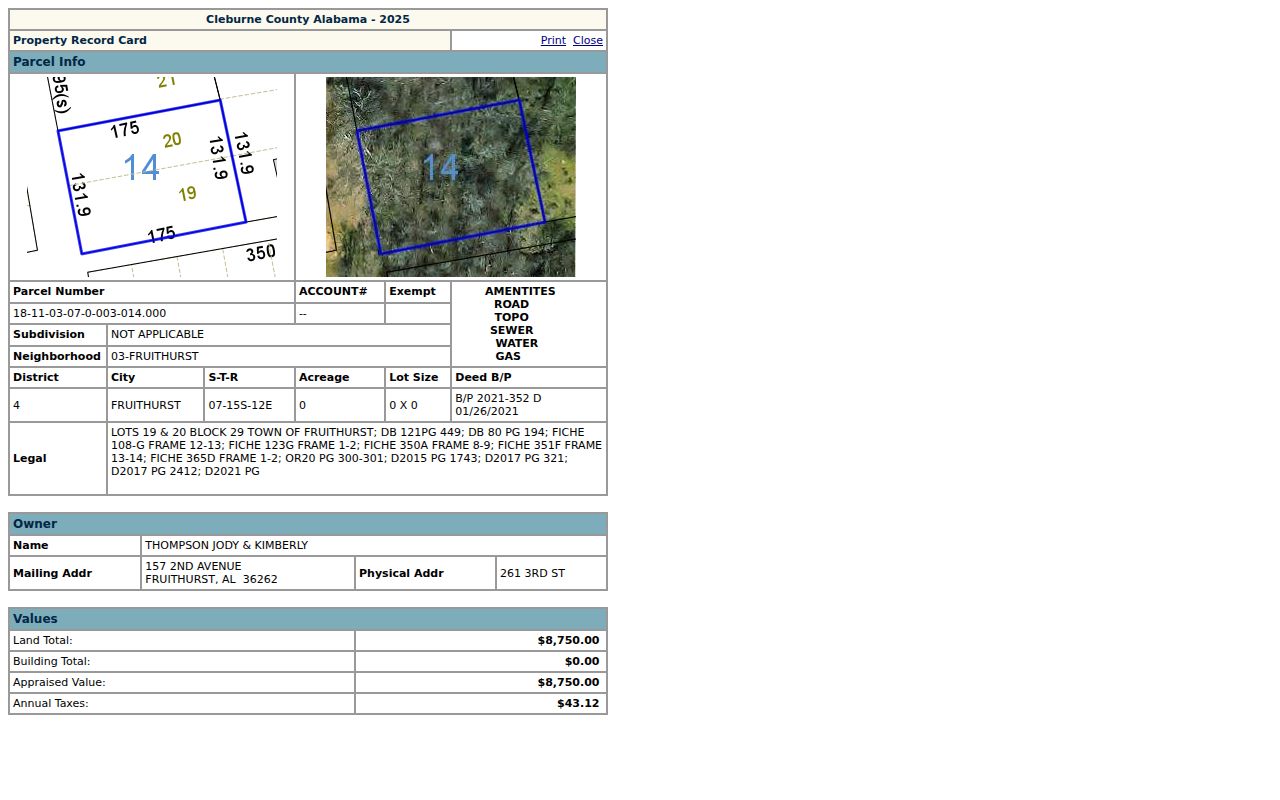
The card also points to the deed. That pointer lets you confirm the value record and the transaction record actually describe the same legal parcel.
Apply Alabama's Class Percentages Correctly
Alabama's class system sets the rates. Per Alabama Department of Revenue assessment guidance, Class I utility property is assessed at 30 percent. Class II property not otherwise classified is assessed at 20 percent. Class III qualifying agricultural, forest, owner-occupied single-family residential, manufactured-home, and historic property is assessed at 10 percent. Class IV private passenger vehicles sit at 15 percent. Cleburne County's own page carries conflicting Class II and Class III wording. Rely on current state guidance for percentages. Confirm the parcel's actual class with the Revenue Commissioner.
Value vocabulary
Appraised value is the mass-appraisal figure, and assessed value applies the class rate to it. An assessment ratio is simply that percentage. Consideration means a transaction amount or recital, while reassessment updates the valuation record itself.
Understand the New Seven Percent Assessment Cap
Alabama's HB73, Act 2024-344, caps eligible annual taxable assessed-value increases at seven percent for Class II and Class III property within the covered cycle. Fair-market or current-use appraisal continues underneath the cap, per the state. The cap does not turn assessed value into sale value. Newly or never-assessed property may not qualify at all. Ownership changes, use shifts, improvements, reclassification, or exemption status can all complicate year-to-year comparisons. Whatever value you copy, keep the class and the year attached to it.
A Fruithurst Value Shows Why Labels Matter
A sampled Fruithurst card shows why labels matter. It reports an $8,750 appraised or land value. The building total and lot/acreage dimension both display zero. The card still carries a Town of Fruithurst Block 29 legal description. It also includes deed references. That $8,750 is not a verified sale price. It is not a title value, or proof the land sits vacant. Component fields, legal descriptions, and transaction records each need separate reading. This local example beats any generic price-per-acre assumption you might otherwise apply. Note: A zero building component alone does not prove a parcel is vacant, unbuilt, or free of improvements.
Separate Cleburne County Sale Price from Assessment
The last-sale field on a parcel card offers a useful date and amount clue. The recorded deed remains the better source for the transaction itself. Search its book/page in the Cleburne Probate land index. Read the deed. The card rarely tells the whole story. Alabama also imposes recordation taxes under Title 40, Chapter 22. Those charges are one-time filing costs, not annual property tax. They say nothing about market value. A nominal, family, estate, trust, or partial-interest transfer can make consideration a poor market comparison too.
Distinguish Land, Building, and Improvement Detail
Cleburne GIS offers separate Land, Building, and Improvement search families, each with component-level filters. The improvement cards add structural detail the main parcel summary does not show the same way. The county improvement report illustrates that separate layer of the valuation system.
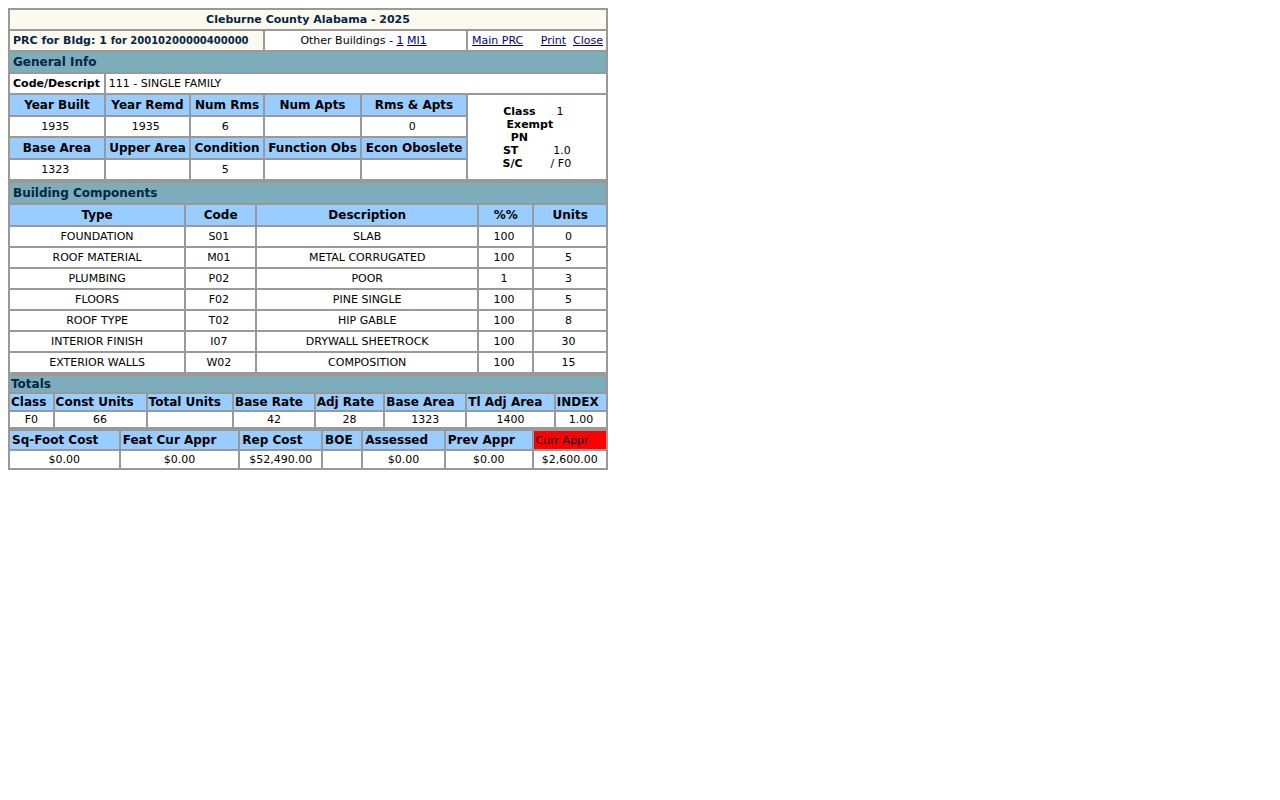
Check improvement details against the right card and year. They explain an assessment component, but they are no substitute for a private inspection or appraisal.
Account for Exemptions Without Rebuilding the Tax Bill
A homestead or similar qualifying status can change taxable treatment without changing who holds title. Alabama covers a primary owner-occupied single-family home of up to 160 acres. Separate age, disability, and blindness provisions also apply. All are subject to local filing and proof. Keep the distinction narrow on the value page. Appraised, assessed, and taxable assessed figures can differ because of class and statutory treatment. Payment status, delinquency steps, and appeal procedure live elsewhere. See the Cleburne County property tax records guide for those details.
Know What Cleburne County Property Value Cannot Say
County assessment is mass appraisal for public taxation. It cannot account for every interior condition, private repair, financing term, buyer motivation, or current offer. A recorded sale price is historical, and it may not even be an arm's-length market transaction.
Assessment is not an appraisal. Cleburne County assessed value is a tax figure. It is not a promise of what the property would sell for today.
For a consequential estimate, treat the public record as one documented input. Check its year and class, review comparable arm's-length transactions, inspect the property, and obtain qualified valuation help.